Introduction
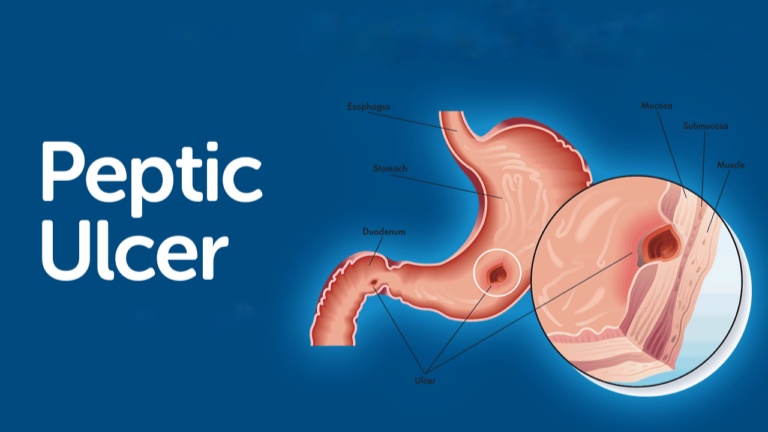
Peptic ulcer disease (PUD) refers to open sores developing on the inner lining of the stomach, duodenum (upper part of the small intestine), less commonly in the esophagus. The global prevalence varies, but PUD remains a significant health issue due to its potential complications and recurrent nature. About 10% of people will develop a peptic ulcer in their lifetime with 4%–10% prevalence globally. In the U.S., roughly 500,000 new cases/year, mostly affecting those aged 25–64.
Types
Peptic ulcers are classified based on their location into the following types:
- Gastric ulcers: Develop in the stomach lining. Pain often worsens after eating.
- Duodenal ulcers: Form in the duodenum. Pain may improve immediately after eating but often returns later.
- Esophageal ulcers: Occur in the lower esophagus, typically due to acid reflux or medication-induced irritation.
Causes
The main reason for peptic ulcer is an imbalance between the digestive tract’s protective lining and aggressive factors like stomach acid. This imbalance may arise due to following causes:
- Helicobacter pylori (H. pylori) infection: This bacterium weakens the defensive mucous barrier, causing irritation and chronic inflammation, leading to ulcer formation in the stomach or duodenum. With worldwide prevalence between 20–80%, higher in lower-income regions it is a major cause.
- Nonsteroidal anti-inflammatory drugs (NSAIDs): Drugs such as aspirin and ibuprofen inhibit protective substances in the mucosa, increasing susceptibility to acid injury.
- Other causes: stress (physical/physiological), excessive alcohol, smoking, radiation therapy, Zollinger-Ellison syndrome, Crohn’s disease, infections, ischemia, certain chronic diseases, rarely gastric cancer.
Risk Factors
- Older age: Higher risk with increasing age.
- Unhealthy dietary habits: Taking irregular, hot or spicy meals predisposes to peptic ulcer in individuals with pre-existing risks.
- Smoking and Alcohol consumption
- Chronic NSAID use
- Chronic Stress
- Comorbid conditions: Diabetes, severe systemic illness
Signs & Symptoms
Most peptic ulcers are symptomatic, but severity varies:
- Pain: Epigastric (burning/gnawing) pain that may vary in timing based on the ulcer location:
- Gastric ulcer: pain worsens after meals.
- Duodenal ulcer: pain improves with food, recurs when stomach is empty.
- Other symptoms:
- Bloating
- Nausea and vomiting
- Loss of appetite
- Unintended weight loss
- Indigestion
- Heartburn
- Fatigue
- Dark, tarry stools (melena) or vomiting blood (indicate bleeding ulcer).
- Some small ulcers may be asymptomatic.
Complications
- Bleeding: Ulcers can erode into blood vessels, causing life-threatening gastrointestinal hemorrhage. Occurs in up to 15% of cases; may require endoscopic or surgical intervention.
- Perforation: The ulcer may penetrate the stomach or duodenal wall, resulting in peritonitis (severe abdominal infection).
- Gastric outlet obstruction: Scarring or swelling may block the passage of food, causing vomiting and weight loss.
Prevention
- Eradicate H. pylori: Screen and treat H. pylori with appropriate antibiotic therapy.
- Avoid long-term NSAIDs: Discuss alternative pain management with a healthcare provider—if NSAIDs are needed, use the lowest effective dose and for the shortest duration possible.
- Lifestyle modification: Quit smoking, limit alcohol, avoid irritants like caffeine/spicy and hot foods and beverages.
- Stress ulcer prophylaxis: PPI/H2 blockers in high-risk hospitalized patients.
Bibliography
[1] https://www.aafp.org/pubs/afp/issues/2007/1001/p1005.html
[2] https://pubmed.ncbi.nlm.nih.gov/15603370/
[3] https://www.ncbi.nlm.nih.gov/books/NBK534792/
[4] https://pmc.ncbi.nlm.nih.gov/articles/PMC6140150/
[5] https://www.mayoclinic.org/diseases-conditions/peptic-ulcer/symptoms-causes/syc-20354223
[6] https://my.clevelandclinic.org/health/diseases/10350-peptic-ulcer-disease
[7] https://www.mediresonline.org/article/peptic-ulcer-disease-and-its-implications
[8] https://www.sciencedirect.com/science/article/pii/S2949752324000517